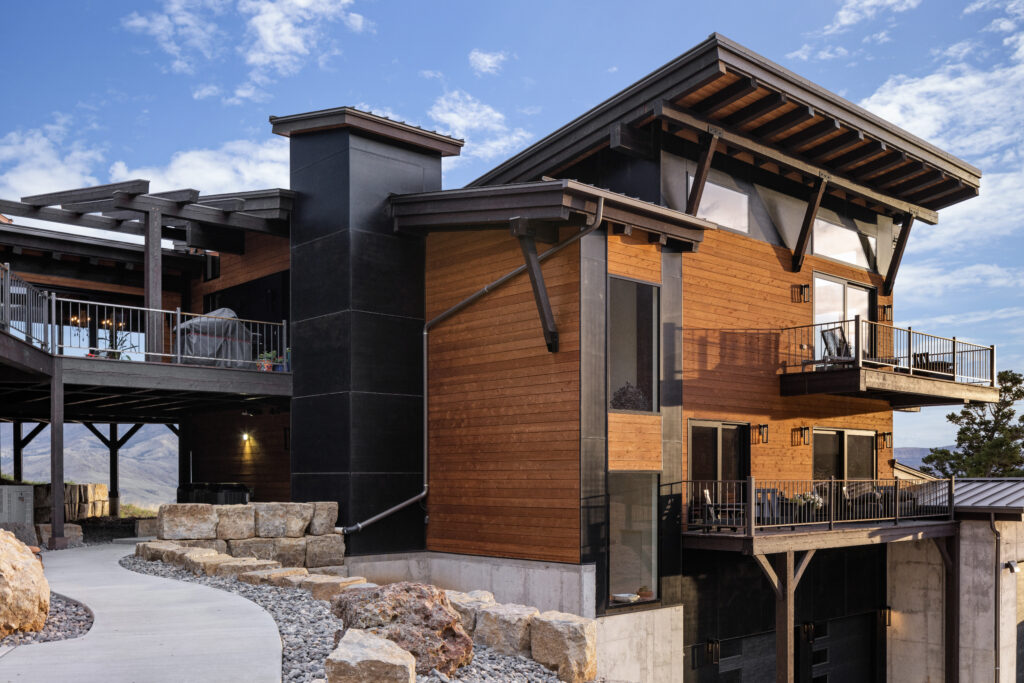
Designing a custom home is deeply personal. By the time clients begin working with Tabberson Architects, most have been envisioning their home for years, sometimes decades. They arrive with inspiration, ideas, and excitement. According to senior project designer Ray Wilk, that passion is a strength, but only when paired with clarity.
What Clients Should Know Before Starting a Custom Home
Ray puts it simply:
“As a client, you’ve probably been dreaming about your custom home for a long time. You likely have a lot of ideas.”
That’s expected. But successful projects begin when those ideas are thoughtfully prioritized!
“My advice is to pick a few of them as your must-haves and a few more as would-be-nice-to-haves. Too many ideas tend to be difficult to achieve in a comprehensive, consistent design idea.”
This early self-awareness sets the tone for the entire process. It allows the design team to shape a home that feels intentional, cohesive, and aligned with both lifestyle and budget.
Understanding Scope Creep in Custom Residential Design
One of the most common challenges in high-end residential projects is something designers call scope creep.
“Scope creep is a phenomenon that occurs in all types of design where the endpoint of your design is substantially more than what it was outlined at the beginning.”
That growth can show up in multiple ways, square footage, complexity, cost, or schedule.
“More in terms of cost or footage. All of the above.”
Ray emphasizes that setting realistic limitations early is not about restricting creativity. It is about protecting the project.
“Having a realistic limitation at the beginning of the project helps control the scope so it doesn’t creep into the realm of not being able to be achieved.”
How Small Decisions Can Have Big Impacts
Scope creep rarely happens all at once. It is incremental…
“Maybe you realize you have some attic space, and then you decide, ‘Let’s put a bedroom and bathroom in there.’ Then you might also want a kitchenette.”
What feels like a minor adjustment can quickly add up.
“You potentially just added 800 square feet that wasn’t in the original program.”
The same pattern often happens in basements, bonus rooms, or secondary spaces, areas that seem flexible early on but carry real structural, mechanical, and budget implications.
Why Architects Care So Much About the Original Scope
From the outside, it may seem like architects resist change. In reality, the concern is rooted in responsibility.
“From our point of view as a designer, our top priority is to have all of our designs become reality.”
Architects can design almost anything!
“We can design limitless, and that’s why it can be a potential threat to many projects. On paper, a few strokes of the pen are easy, but they can have ramifications that cost a lot of extra money or impact schedules.”
Ray explains that the most successful projects take a proactive approach.
“The proactive approach is always the best approach, to premeditate and set guidelines early in the design, and then have everyone work together to stick to that.”
Every Custom Home Has Its Own Story
That does not mean projects are rigid or inflexible.
“Every custom building is its own story.”
Design is inherently exploratory, and evolution is often part of the process.
“One of the purposes of the design phase is to be exploratory and to have an open mind.”
What matters is diligence and alignment.
“We do our diligence on each project to ensure that even if it evolves, it stays within the parameters of a successful project.”
At Tabberson Architects, success means more than beautiful drawings. It means a home that is built, completed, and lived in as envisioned!